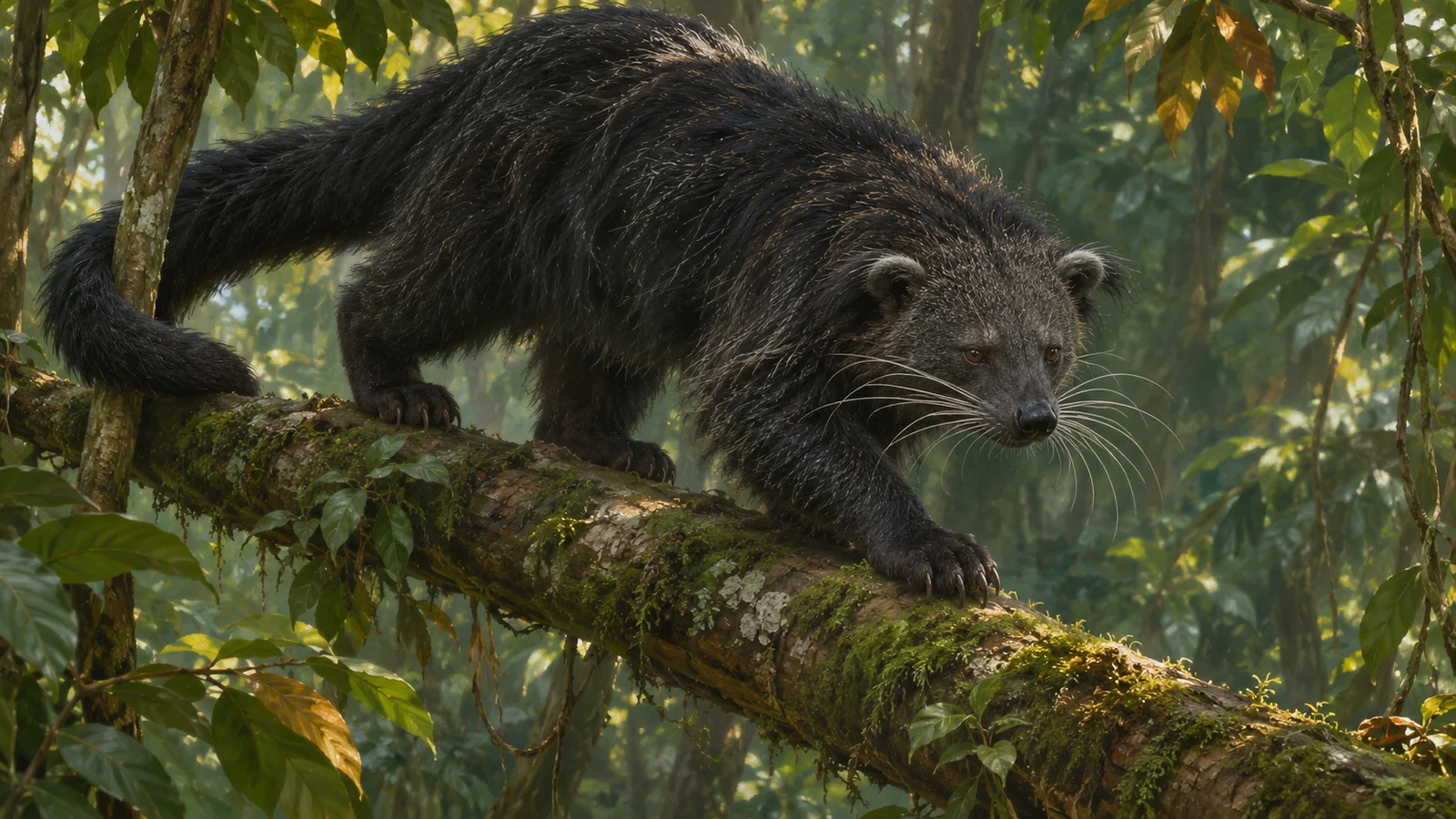
A trace left on a branch
A branch can hold a trace of a binturong after the animal has moved on. In a 1974 study at the Smithsonian’s National Zoo, zoologist Devra Kleiman observed a pair of binturongs in captivity. She described how they pressed a scent gland near the base of the tail against particular surfaces, including a slanted branch. She recorded urination as a separate behavior and saw urine wet the tail. The distinction matters because spotting a scent mark on a branch tells you little about which substance was left behind.
A familiar molecule in the lab
In 2016, Lydia Greene and her colleagues analyzed urine samples from 33 captive binturongs (Arctictis binturong). They used gas chromatography and mass spectrometry to separate and identify volatile compounds. They detected 2-acetyl-1-pyrroline, or 2-AP, in all 33 animals. The same compound contributes to the smell of freshly popped corn, where it can form during heating. That gives the resemblance a chemical explanation.
What another binturong might pick up
The compound was more abundant in males in that sample. The researchers suggested that a scent mark might carry information about the animal that left it. Their measurements did not show how another binturong interprets the mark in the wild. The researchers also proposed that microorganisms could help produce 2-AP, a possibility described by Duke University. To test that idea would require finding where the compound forms and under what conditions. Identifying what reaches the nose was the first part of the puzzle.