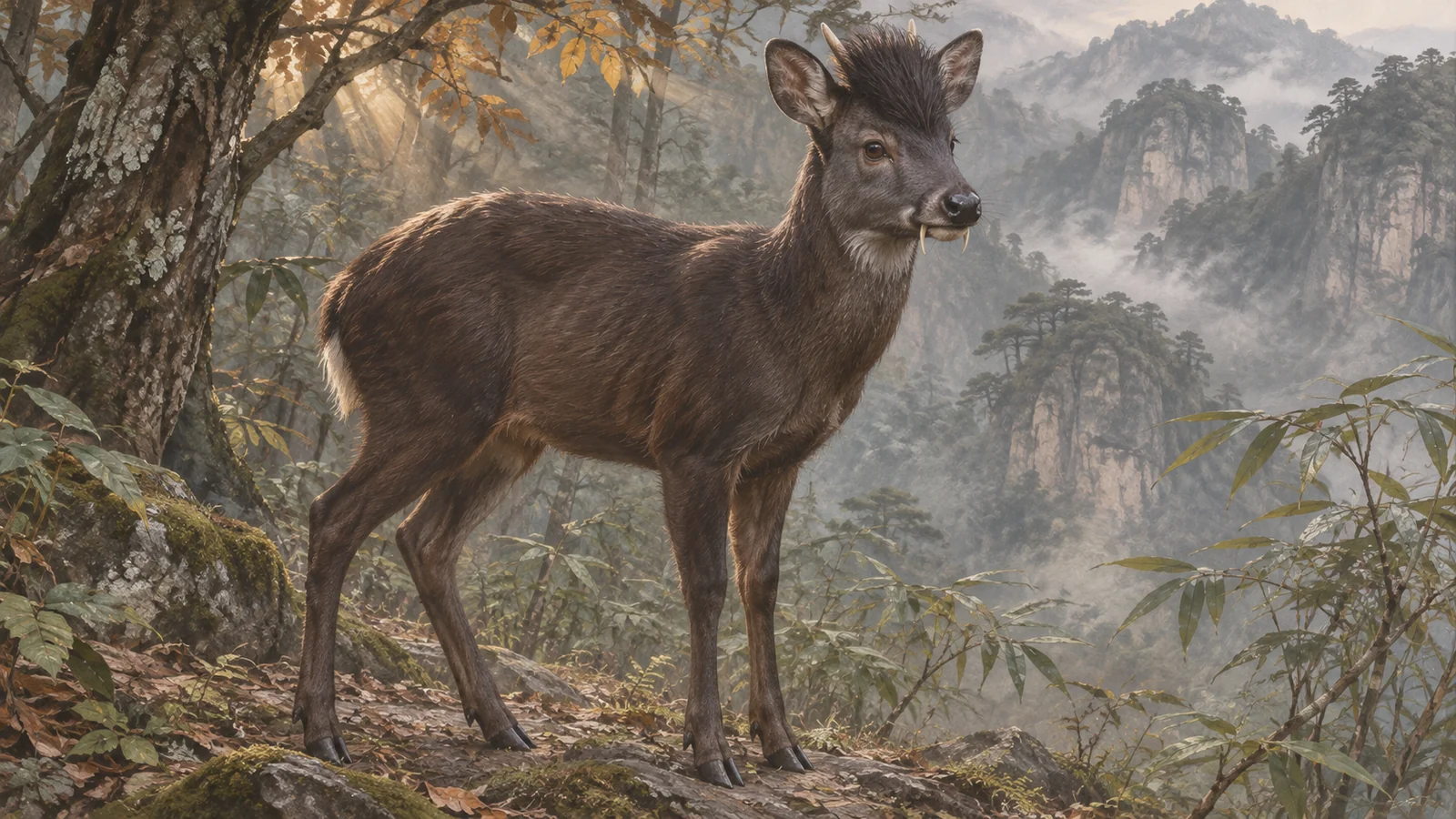
A tuft that hides the antlers
On the tufted deer (Elaphodus cephalophus), a clump of stiff hair stands between the ears. Both sexes have it. A male's antlers are short and unbranched, and his hair can hide them almost completely. Along with the dark brown coat, those details are useful when looking at a side-on image. A profile also shows how the upper canines emerge beneath the lip and point downward.
What the teeth do
Both sexes have elongated upper canines, which develop more strongly in males. The Los Angeles Zoo describes males using them during fights with rivals. The European Association of Zoos and Aquaria and Rotterdam Zoo also document territorial fights between males in zoos, while noting how much remains to be learned about the species' behaviour. The fangs are easiest to understand in the context of those encounters.
Feeding close to the ground
The same European zoo guide describes the tufted deer as primarily a browser. Leaves and twigs are among its foods, along with seeds and wild fruits. It looks for food on the ground and in low foliage. A close-up of the mouth gives a striking view of the teeth. A wider view of a feeding animal shows how close to the ground it finds food.
Morning and evening at Gongga
The species lives in humid mountain forests across parts of China. In the Gongga Mountain reserve in Sichuan, a study published in 2022 analysed records from camera traps spanning 2012 to 2021. The researchers estimated two daily activity peaks, one in the morning and one around dusk, with some shifts between the dry and rainy seasons. A separate study at Anzihe also found a morning peak and a second in the late afternoon. Each result describes the pattern recorded at its own site.