A shape with a job
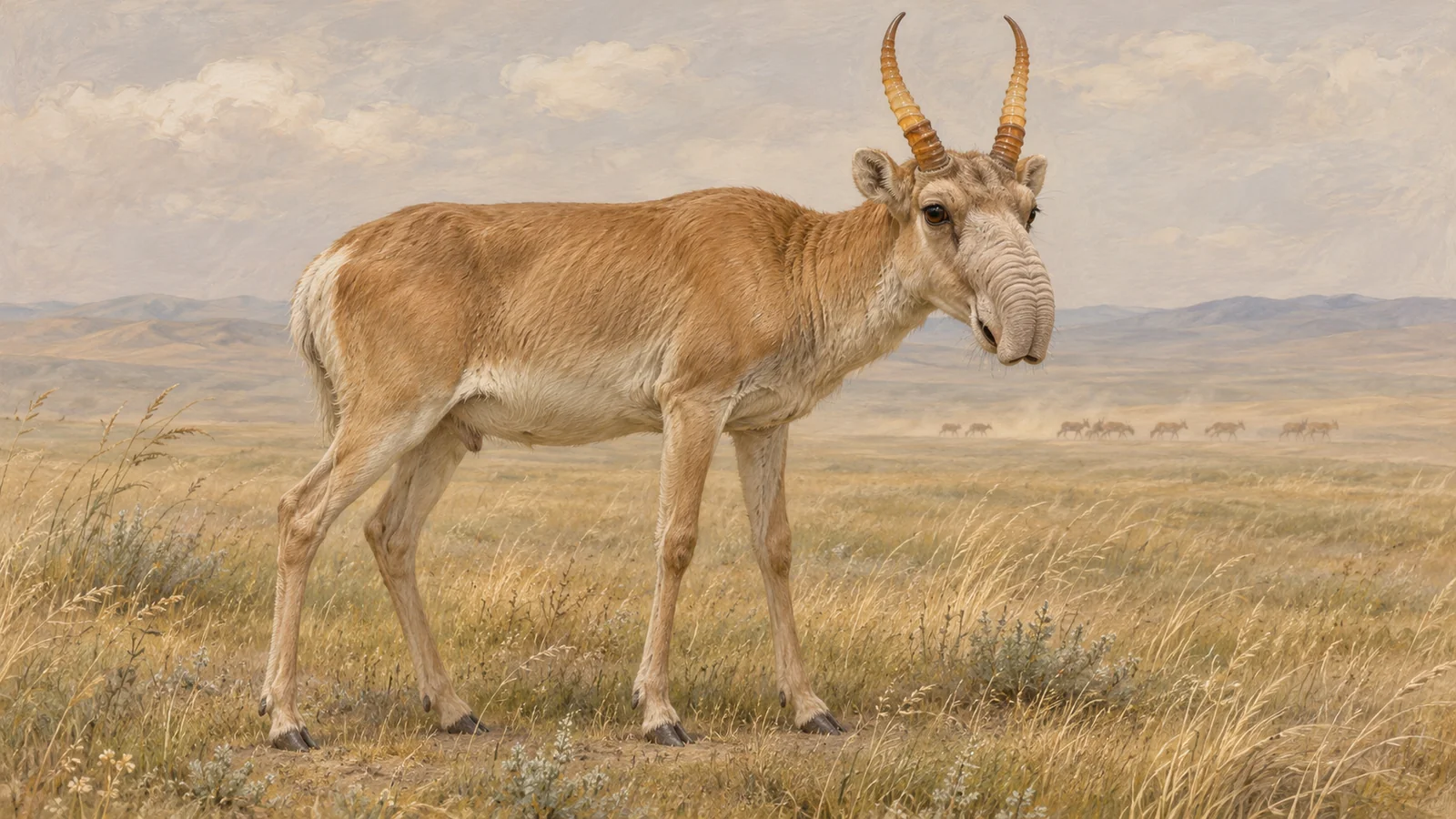
The nose of the saiga (Saiga tatarica) tends to attract all the attention. It is large, flexible and hangs over the mouth. Understanding it means looking inside: the anatomical study by Andrew Clifford and Lawrence Witmer describes an enlarged nasal entrance, tissues that can alter airflow and surfaces that produce secretions.
The researchers interpret these structures together as an adaptation to dusty environments. Inhaled particles can be trapped before the air continues towards the lungs. The shape becomes easier to understand when connected with an animal that lives and moves through dry landscapes, rather than viewed only as an unusual face.
The steppe demands movement
A fact sheet published in 2026 by the Convention on Migratory Species and the Global Initiative on Ungulate Migration follows a specific example: the Ural population in western Kazakhstan. Its movements connect southern wintering areas with summer ranges farther north, sometimes several hundred kilometres apart.
During summer, the animals follow rainfall and growing vegetation. Snow depth influences their winter movements and access to food. A fixed route followed identically by every saiga would therefore be the wrong picture. The fact sheet describes this population and its conditions, rather than prescribing a distance travelled by the entire species.
What changed in 2023
In December 2023, the Wildlife Conservation Society reported the saiga's reclassification on the IUCN Red List from Critically Endangered to Near Threatened. That milestone reflected substantial recovery, particularly in Kazakhstan, following years of protection, monitoring and cooperation.
The date matters: this is a documented change from 2023, not a newly completed census. The same announcement warned that recovery was uneven across the animal's range, while illegal trade, disease and habitat change remained problems. An improved category needs sustained work if that improvement is to last. The recovery story is encouraging precisely because it shows what continued conservation can achieve.
Look beyond the outline
Protecting a migratory animal also means keeping connections between its feeding, breeding and resting areas. The Ural fact sheet identifies linear infrastructure and fences as obstacles to movement. Suitable grazing becomes less useful if the herd cannot reach it.
Within Stranger Animals, the saiga encourages a closer look at features that initially seem strange. Its nose tells one part of the story; open spaces and the passages between them complete the picture. Understanding both helps us appreciate the real animal as well as the character it inspires.